





































X

Quote Summary

  • You have no products in your cart.

whatsappWhatsapp catalogueDownload Catalogue

Solar Panel Lockout Tagout: A Guide to Isolating PV Arrays, Inverters & Batteries

date

Here is the most dangerous misconception in solar maintenance: that you can switch a photovoltaic array off. You cannot. A solar module is a current source, it generates DC voltage the instant light strikes the cells. Open every disconnect on the farm and the modules, and the conductors running from them, stay live. That single fact makes solar panel lockout tagout fundamentally different from any other energy-control task, and it is why so many serious solar incidents happen to experienced technicians who “isolated” an array and assumed it was dead.

This guide sets out how hazardous energy control actually works on a utility-scale solar farm across PV source circuits, inverters, battery storage, medium-voltage collection systems and trackers, and how to build a lockout tagout programme that keeps crews alive and stands up to an OSHA 1910.147 audit. Whether you run a single 5 MW site or a national fleet of solar farms in the US, UK, Australia or Canada, the principles here apply.

What is solar panel lockout tagout?

Solar panel lockout tagout (LOTO) is the method of controlling hazardous energy in a photovoltaic system so a worker is never exposed to an energy source that could injure them. Under conventional LOTO you isolate the source, lock the isolating device in the OFF position, tag it, and verify a zero-energy state. On a solar farm, that model only partly works, and the part that fails is the part that gets people hurt.

The principle worth internalising: protection on a PV system comes from isolating what you can isolate, and treating what you cannot isolate as permanently live. The grid connection, the inverter output and the medium-voltage collection network can all be brought to a genuine electrically safe work condition. The PV array cannot, not while the sun is up.

So solar LOTO is really two disciplines running in parallel: classic hazardous energy control on everything downstream of the array, and rigorous energy-isolation and live-working practice on the array itself. Get the framing right and every device, procedure and standard that follows makes sense. Get it wrong and you have a padlock hanging on a DC disconnect while a worker upstream of it holds a live 1500 V DC conductor.

Why you cannot de-energise a solar array (the daylight problem)

Every other section of this guide depends on this one. A PV cell converts light directly into electrical energy; there is no isolating device between the sunlight and the voltage, and no “off” switch. A string of modules in full sun sits at its open-circuit voltage (Voc) whether or not anything downstream is connected, and on a modern 1500 V DC utility array that Voc can approach or exceed the system rating, because Voc actually rises in cold, bright conditions. A frosty, sunny winter morning is the worst case, not the best.

That has hard consequences for how you plan work:

  • Opening the DC disconnect does not make the modules or their conductors safe. It isolates the array from the inverter. Everything on the array side of that disconnect stays live.
  • Working at night reduces the hazard but does not eliminate it. A PV module’s output is “wild”, uncontrolled and driven purely by available light so floodlights, a bright moon or approaching dawn can still produce hazardous voltage across a large string. Night work is a risk-reduction measure, not a substitute for treating conductors as live.
  • Covering the modules is an OSHA-recommended protective measure but not a guarantee of zero energy. OSHA’s solar guidance advises covering panels while work is done on or near them, and it is worth doing. But partial shading, edge light and the sheer number of modules mean covering reduces the hazard rather than delivering a verified de-energised state. It supplements isolation and verification; it does not replace them.
  • DC arc flash is a genuine and under-appreciated hazard. A fault on a 1500 V DC source circuit can sustain a continuous arc, because DC has no natural current zero-crossing to help extinguish it the way AC does. Add stored energy in inverter DC-link capacitors, always-live battery storage, and moving trackers, and it is clear why solar farms demand more than “isolate and test dead”.

When is LOTO required on a solar farm?

Lockout tagout is required whenever someone services or maintains equipment and exposure to hazardous energy like electrical, stored or mechanical is possible. On a solar farm that covers replacing modules and combiner fuses, servicing inverters, working on the medium-voltage collection system, maintaining transformers and switchgear, working on battery storage, and servicing tracker drives.

In the United States, the standards stack up depending on what you touch. OSHA 29 CFR 1910.147 governs the control of hazardous energy during servicing and maintenance, but it expressly excludes electrical-utilisation hazards, which fall under Subpart S – 29 CFR 1910.333(b), the standard requiring circuits to be de-energised and locked or tagged before electrical work. For utility-scale generation, a third standard is often in play: 29 CFR 1910.269, covering the operation and maintenance of electric power generation, transmission and distribution installations.

OSHA’s own solar guidance is explicit that both routes can apply, stating solar employers “may be required to implement lockout/tagout procedures outlined in OSHA standards at 29 CFR 1910.269(d) or at 29 CFR 1910.147”. Whether a given plant’s generation and interconnection substation fall under 1910.269 or under general-industry rules depends on the installation and how it interconnects, this is genuinely an interpreted area. The practical answer: identify which standard your site operates under with your competent authority, and write your energy control programme accordingly. What is not in doubt is that some combination of these standards applies to essentially all utility-scale O&M.

Commissioning is a high-risk trigger of its own. During phased energisation, strings, combiners and inverter blocks are brought live progressively while adjacent work continues, so live and dead sections coexist across the site for weeks. Rigorous LOTO integrated with a permit-to-work system, plus clear physical demarcation of energised zones, is essential throughout.

Regulatory requirements vary by jurisdiction and industry. Always verify current requirements with your local authority or a qualified electrical safety professional.

What you must isolate: arrays, combiners, inverters, BESS, collection and trackers

A solar farm hides a remarkable number of independent energy sources behind what looks like a simple field of panels. A defensible isolation identifies and secures everyone.

PV source and output circuits (DC): The strings and their combiner boxes. Isolate at the DC disconnect and at combiner switch-disconnectors, and lock them but remember the modules upstream remain live. Combiner-box isolation defines the boundary of your work zone, not a dead zone.

Inverters and DC-link capacitors: Central and string inverters convert array DC to grid-synchronous AC. Isolate the inverter on both the DC and AC sides and lock both. Critically, the DC-link capacitors store energy after isolation, wait the manufacturer’s specified discharge time (commonly several minutes) before approaching the internals. Do not assume instant discharge, and do not trust a discharge lamp you have not verified.

Battery energy storage (BESS): Increasingly co-located with solar. A battery cannot be switched off as it is a continuous DC source and must be treated as permanently live until isolated at its dedicated breaker or disconnect and proven dead at the terminals you are working on. Lithium-ion BESS adds thermal-runaway and arc-flash hazards, and BMS interlocks are not a substitute for physical isolation.

AC collection and medium-voltage system: Inverter outputs feed an AC collection network, often medium voltage, for example 34.5 kV in many US plants through pad-mounted or skid transformers to MV switchgear and the interconnection substation. This side can be brought to a true electrically safe work condition, and standard MV LOTO and switching discipline apply, including grounding/earthing after isolation.

Grid backfeed: Energy can flow from the grid as well as from the array. Never rely on the inverter’s anti-islanding protection as an isolation method, it is a protection function, not an isolating device. Isolate and lock the grid connection as a defined source.

Trackers and auxiliary systems: Single-axis trackers contain motors, actuators and stored mechanical energy; a tracker that looks “off” can still move under wind load, gravity or stored energy. Stow the tracker, isolate and lock the drive, and mechanically block where required. Add station/auxiliary power, SCADA and substation power-factor capacitor banks to the inventory.

Browse the range: Explore the electrical lockouts and circuit breaker lockouts at E-Square – weatherproof devices built for outdoor solar plant, in single units and bulk site quantities.

Electrical isolation vs Lockout Tagout on a PV system

These terms get used loosely, and on a solar farm the difference is safety-critical.

Energy isolation is the act of separating equipment from a source using an energy isolating device – a DC disconnect, an AC circuit breaker, an MV switch-disconnector, a battery breaker. Lockout tagout is what secures and proves that isolated state: the lock prevents the device being returned to service, the tag records who and why, and verification confirms the condition. Together with test-before-touch, isolation, lockout and verification create an electrically safe work condition (ESWC) under NFPA 70E.

Here is the solar-specific trap: on the AC and MV side you can achieve an ESWC; on the illuminated DC array side you cannot. No amount of isolation makes a sunlit string dead. So the correct model is two-track:

  • Downstream of the array (inverter AC, collection, substation, grid): isolate, lock, tag, discharge stored energy, test dead, earth where required – genuine zero-energy work.
  • On the array / DC source side: isolate to establish a work boundary, then treat every conductor beyond that boundary as live using rated tools, PPE and live-working procedures, and verifying voltage rather than assuming its absence.

Confusing the two – applying “isolate and it’s dead” logic to the DC side is the error behind a large share of solar electrical injuries.

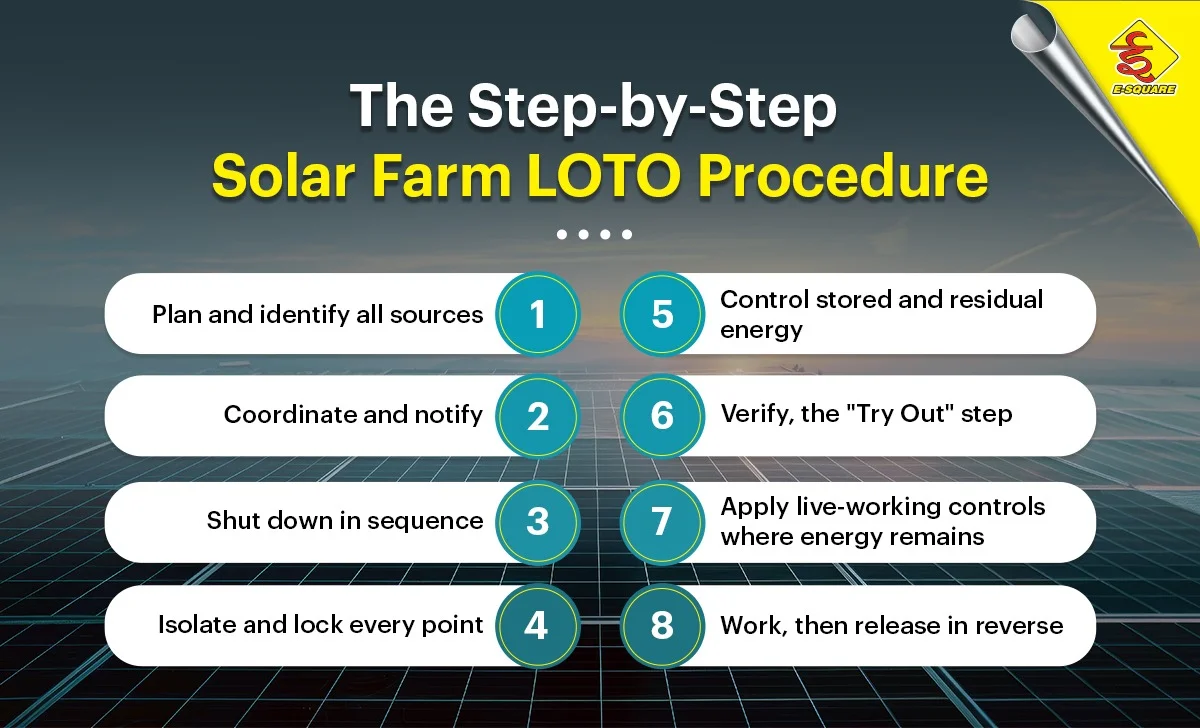
The step-by-step solar farm LOTO procedure

This is the core lockout tagout procedure for a utility-scale PV plant, written for the authorised employee and following the LOTOTO discipline: Lock Out, Tag Out, Try Out. It aligns with the process for establishing an electrically safe work condition in NFPA 70E-2024, Article 120, adapted for the reality that the array cannot be de-energised.

step by step solar farm LOTO procedure

  1. Plan and identify all sources. Using the equipment-specific procedure and single-line diagram, list every energy source in scope: DC source circuits, combiners, inverter DC and AC sides, DC-link capacitors, BESS, AC collection, MV switchgear, transformers, grid backfeed, trackers and auxiliary power. Raise the permit to work.
  2. Coordinate and notify. Inform all affected employees, the control room / SCADA operator and, where the interconnection is involved, the utility. Solar farms are remote and multi-crew so coordination is part of the isolation, not an afterthought.
  3. Shut down in sequence. Command an orderly inverter shutdown, then open the AC disconnect to separate the inverter from the collection system, then open the DC disconnect and combiner isolators. Sequence matters: break load under the right conditions to limit arcing.
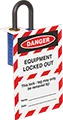
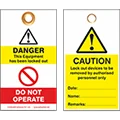
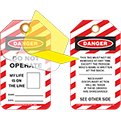
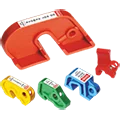
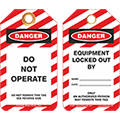
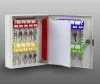
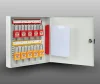
  4. Isolate and lock every point. Apply a safety padlock to each isolating device through the correct lockout device – DC disconnect lockout, circuit breaker lockout, rotary / switch-disconnector lockout, combiner enclosure lockout, battery breaker lockout, tracker drive isolation. Where multiple crews share an isolation, route the keys through a group lock box so every authorised employee applies a personal lock. Attach a “Do Not Operate” tag at each point recording the worker’s name and date, the energy sources and isolating devices, the magnitude of any stored energy, and the work being performed.
  5. Control stored and residual energy. Wait the inverter manufacturer’s capacitor discharge time before opening the unit. Confirm the BESS is isolated at its breaker. Stow and mechanically block trackers. Discharge and earth substation capacitor banks and MV circuits per your switching procedure.
  6. Verify, the “Try Out” step. Using a voltage tester correctly rated for the system (CAT III / CAT IV, rated to the full DC and AC voltages present up to 1500 V DC on modern arrays), prove the tester on a known live source, test for absence of voltage across all conductors and to earth, then re-prove the tester. On the DC array side, verification confirms what is live; it does not make the modules dead. Treat illuminated source conductors as energised regardless of any downstream meter reading. This is the step most often skipped and the one that gets people killed.
  7. Apply live-working controls where energy remains. For unavoidable work near live DC source circuits, use insulated tools, appropriately rated gloves and PPE, single-pole working discipline, and cover or blank adjacent live parts where practicable.
  8. Work, then release in reverse. On completion, confirm tools are clear and covers refitted. Each worker removes only their own lock. The area is confirmed clear, and the plant is re-energised in a controlled, sequenced manner watching inrush and following the phased energisation plan.

Common mistakes to avoid: assuming an open DC disconnect makes the array dead, relying on anti-islanding instead of a locked grid isolation, opening an inverter before capacitor discharge, and forgetting a tracker can still move.

DC arc flash: the hazard NFPA 70E makes you assess

Arc flash is usually discussed as an AC problem, which is exactly why the DC hazard on a solar farm catches people out. A DC arc has no natural current zero-crossing, so once struck it can sustain itself far more readily than an AC arc and a 1500 V DC source circuit backed by a large array or a battery has plenty of energy to feed it.

NFPA 70E-2024 requires a DC arc flash risk assessment for tasks where a DC arc flash hazard exists, using DC-specific incident-energy methods (the Maximum Power method or IEEE/industry DC models) rather than the familiar AC calculations. The output drives the arc flash boundary and the arc-rated PPE category, just as it does on the AC side. The three highest-risk moments on a solar site are opening a combiner under load, working on or near the DC-link on an inverter, and any work on the battery DC bus.

The practical rule mirrors the AC world: treat DC source and battery conductors as live and dress for the assessed incident energy until verification proves otherwise, and on the illuminated array, verification never proves the modules dead.

Choosing the right lockout devices for solar

Solar plant is outdoors, high-voltage DC, and spread across large sites so device selection is about correct fit, environmental durability and dielectric safety, not catalogue price.

Isolation pointRecommended deviceSelection notes
DC disconnect / switch-disconnectorRotary / disconnect switch lockoutSized to the handle; UV and corrosion-resistant for outdoor use
MCB / MCCB (string, aux, distribution)Circuit breaker lockout (MCB/MCCB)Matched to breaker frame
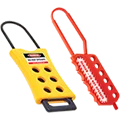
Combiner box / enclosureEnclosure or hasp lockoutSecures the cabinet; hasp lets multiple workers lock on
Inverter AC/DC isolatorsDisconnect / breaker lockoutBoth sides isolated and locked
Battery (BESS) breakerCircuit breaker lockoutTreat the battery as always live
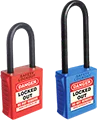
Multiple workers, single isolationGroup lock box + safety padlocksOne personal lock per authorised employee
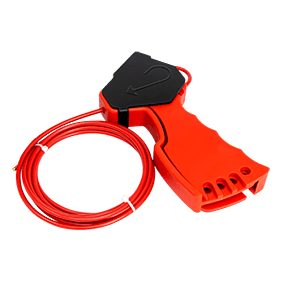
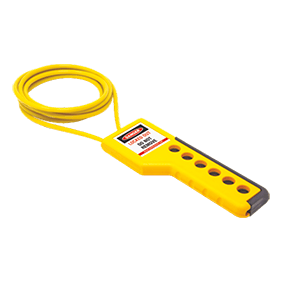
Awkward or oversized pointsCable lockout deviceUniversal, threads through multiple points

Key buying criteria for solar:

  • Dielectric, non-conductive materials for all electrical work – nylon padlock bodies and shackles.
  • Weatherproof, UV-stable, corrosion-resistant construction for years of outdoor exposure – a padlock that seizes after one winter is a safety liability.
  • Correct fit to the specific disconnect and breaker frames on your site.
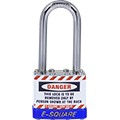
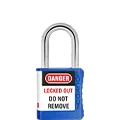
  • Colour-coded, keyed-different safety padlocks so each worker controls their own lock; colour separates crews, contractors and shifts.
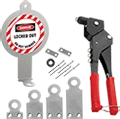
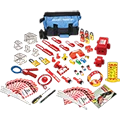
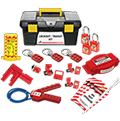
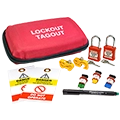
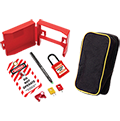
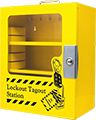
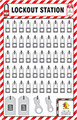
  • Fleet standardisation so any crew can isolate any block the same way: mount an electrical lockout kit or LOTOTO kit at each inverter skid and substation via a LOTO station.

Not sure which disconnect or breaker lockout fits your gear?  Send us your inverter, combiner and BESS makes and models. E-Square’s specialists will spec a weatherproof electrical lockout kit for your solar plant. Get free advice.

Solar EPCs, O&M providers, resellers and multi-site operators.  E-Square supplies LOTO devices in bulk with custom kitting, branding, competitive trade pricing and dedicated account management. Whether you’re equipping one 5 MW site or a national fleet, talk to our team.

Multi-employer sites: O&M crews, EPC contractors and utility coordination

Solar farms are almost never single-employer sites. A single work window can involve the asset owner’s O&M team, an EPC contractor, an inverter or BESS vendor’s field engineers, and where the interconnection is touched, the utility itself. OSHA 1910.147(f)(2) covers this under outside personnel and requires the on-site and contract employers to inform each other of their respective LOTO procedures.

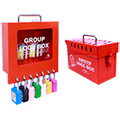
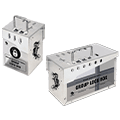
The practical answer is a group LOTO regime built around a group lock box. The primary authorised employee places the isolation locks and secures the keys in the box; every worker who then enters the isolation adds their own personal padlock. The box cannot be opened and power cannot be restored until every worker has removed their lock. For utility interconnection work, isolation and switching are coordinated with the network operator under a formal switching programme, not improvised on site.

Compliance and standards

Solar LOTO sits at the intersection of energy-control, electrical-work and PV-specific standards. Use the ones that bind your jurisdiction and installation, then use NFPA 70E or the local equivalent for the work practice.

RegionStandardKey requirement
USAOSHA 29 CFR 1910.147Written energy control programme, periodic inspection, training
USA – electrical workOSHA 29 CFR 1910.333(b)De-energise and lock/tag before electrical work
USA (utility generation)OSHA 29 CFR 1910.269(d)O&M of electric power generation installations (OSHA cites this or 1910.147 for solar)
USA (work practice)NFPA 70E-2024, Art. 120Establish/verify an ESWC; DC arc flash assessment
USA (installation)NFPA 70 (NEC) Art. 690 & 691PV system disconnecting means; large-scale PV supply stations (≥5 MW)
InternationalIEC 62548 / IEC 60364-7-712PV array design safety and installation requirements
UKEAWR 1989 / BS 7671Safe isolation, competent person, dead-working duty
Australia / NZAS/NZS 5033PV array installation and isolation requirements
CanadaCSA Z460-20 / CECHazardous energy control programme; PV installation rules

In the US, OSHA 1910.147 is the floor for the energy control programme: documented procedures, authorised and affected employee training, and at least annual periodic inspection, while 1910.333 governs the electrical work practices and 1910.269 may govern the generation and interconnection assets. NFPA 70E-2024 provides the consensus method for establishing an ESWC and for assessing arc flash, including on the DC side. The NEC (NFPA 70) sets the installation rules: Article 690 for PV system disconnecting means and Article 691 for large-scale PV electric supply stations of 5 MW and above (note the NEC edition adopted varies by state). Internationally, IEC 62548 and IEC 60364-7-712 carry the PV-specific design and isolation duties.

A standing rule on product language. E-Square’s devices are designed to support compliance with OSHA 29 CFR 1910.147 and its international equivalents but no manufacturer’s device is “OSHA compliant” or “OSHA certified”, because OSHA does not certify products. Compliance is a property of your programme and your competent people, not of a padlock.

Regulatory requirements vary by jurisdiction and industry. Always verify current requirements with your local authority or a qualified electrical safety professional.

Periodic inspection, training and documentation

A defensible solar LOTO programme is documented, inspected and trained, not just equipped.

Periodic inspections. OSHA 1910.147(c)(6) requires each energy control procedure to be inspected at least annually by an authorised employee other than the one using it, with a written certification (employee name, date, equipment ID, inspector name). On a large fleet this is a scheduling exercise as much as a technical one – build it into your O&M calendar block by block.

Training. Authorised employees must be trained on recognition of hazardous energy, the type and magnitude of energy present, and the methods for isolation and verification – including the PV-specific reality that the array cannot be made dead. Affected employees must understand the purpose and use of the procedures. Under CSA Z460, training must be competency-based, with demonstrated practical ability.

Documentation. Every audit asks for the same artefacts: the written energy control programme, equipment-specific procedures for each asset class (inverter, combiner, BESS, MV switchgear, tracker), the isolation register, training records, periodic inspection certifications, and for commissioning and contractor work – permit-to-work records. Keep the current versions in one place; a scattered document trail is where audits go wrong.

Frequently asked questions

Can you de-energise a solar panel for maintenance?

No. A photovoltaic module generates DC voltage whenever it is exposed to light, and it has no off switch. You can isolate the array from the inverter and downstream equipment, but the modules and their conductors stay live in daylight. The safe approach is to isolate what you can, treat all illuminated source circuits as energised, and verify voltage with a correctly rated tester rather than assuming the array is dead.

How do you lock out a solar inverter?

Isolate the inverter on both the DC and AC sides, applying a lockout device and safety padlock to each disconnect, and attach a “Do Not Operate” tag. Then wait the manufacturer’s specified DC-link capacitor discharge time before opening the unit, and verify absence of voltage before any contact. Remember the PV array upstream stays live regardless of the inverter isolation.

What OSHA standard covers solar lockout tagout?

Several apply together. OSHA’s solar guidance states that lockout/tagout may be required under either 29 CFR 1910.269(d) or 29 CFR 1910.147, depending on the installation. 1910.147 covers control of hazardous energy during servicing and maintenance, 1910.333(b) covers lockout/tagging for electrical work, and 1910.269(d) covers a utility-scale plant’s generation and interconnection assets. NFPA 70E-2024 provides the work-practice detail, including DC arc flash assessment.

Is it safe to work on solar panels at night?

Working after dark reduces the hazard because output falls with light, but it does not guarantee a zero-energy state. Artificial lighting, a bright moon and approaching dawn can all produce hazardous voltage across a large string. Night work is a risk-reduction measure, not a substitute for isolating the system, verifying voltage and treating source conductors as live.

How do you isolate a solar battery storage system (BESS)?

Isolate the battery at its dedicated breaker or disconnect, lock and tag it, and verify absence of voltage at the terminals you will work on. A battery cannot be switched off as it is a continuous DC source so treat it as permanently live until proven dead at the point of work, and account for its stored-energy, thermal and arc-flash hazards. BMS interlocks do not replace physical isolation.

What voltage rating do you need for testing solar PV circuits?

Use a voltage tester rated for the full DC and AC voltages present and for the correct measurement category. Modern utility arrays run at up to 1500 V DC, so testers and PPE must be rated accordingly, typically CAT III or CAT IV. Always prove the tester on a known live source before and after testing, following the test-before-touch discipline.

Do solar farms need LOTO during commissioning?

Yes. Commissioning uses phased energisation, so energised and de-energised sections coexist across the site for weeks. You must isolate and lock the sections not yet handed over, integrate LOTO with a permit-to-work system, physically demarcate live zones, and verify state before any contact. Commissioning is one of the highest-risk periods in a solar farm’s life.

How often must solar LOTO procedures be inspected?

Under OSHA 1910.147(c)(6), at least annually, and the inspection must be performed by an authorised employee other than the one who uses the procedure. It is certified in writing with the employee name, date, equipment identification and inspector name. CSA Z460 requires an equivalent annual review; AS/NZS expects review after modification, after an incident, or at minimum every five years.

Conclusion: isolate the boundary, control the stored energy, never trust a “dead” array

Three takeaways for anyone maintaining a solar farm.

You cannot de-energise a PV array. Isolation defines a work boundary, but every illuminated conductor beyond it stays live so verification and live-working discipline are not optional extras, they are the job.

The stored and hidden sources are what catch people out. Inverter DC-link capacitors, always-live battery storage, grid back feed and moving trackers all need their own isolation and control. The array is the obvious hazard; these are the ones that surprise experienced crews.

The right weatherproof device on the right point turns chaos into a procedure. Disconnect lockouts, circuit breaker lockouts, combiner and enclosure lockouts, and group lock boxes turn a sprawling, high-DC-voltage site into a controlled, auditable, repeatable operation that stands up to OSHA 1910.147, 1910.269, NFPA 70E-2024, the NEC, IEC 62548, AS/NZS 5033 and CSA Z460.

Whether you’re an O&M provider looking after a single 5 MW site or a national operator managing thousands of isolation points across a solar fleet, E-Square has the right lockout devices, kits and specialists to back your programme.

Equipping a solar farm or O&M fleet?  Get a bulk quote on disconnect and breaker lockouts, combiner lockouts, group lock boxes and custom LOTO stations, with fast global shipping. Request a quote.

About the Author

Dr. Nalni Gulati

Co-Founder and Director of E-Square Alliance, she serves LOTO and hazardous energy control in industries across 109 countries. Known as "The LOTO Guru," Dr. Nalni Gulati brings 20+ years of OSHA 29 CFR 1910.147 expertise, founded the Big India LOTO Movement, and authored the Hindi-language LOTO guide, 25 Sabse Aam Janleva Lockout Tagout Galtiyan. She has spoken at FICCI, CII, SAIL, and NSC platforms on industrial safety and hazardous energy management, and leads E-Square's RoSPA-accredited Training Academy.

E-Square Blog: Expert Analysis and Best Practices for Isolation Safety

The E-Square blog features advice, information and support on everything related to Lockout Tagout, including best practices, industry news, latest innovations and regulatory updates.

Address

Contact Us

We reply within 4 IST business hours. No commitment required.


    Worldwide Delivery

    Worldwide Delivery

    Via Fastest Mode Available
    Wide Choice

    Wide Choice

    1800+ Items available
    Customisation Available

    Customisation Available

    No MOQ for standard products
    Direct Technical Support

    Direct Technical Support

    From our expert LOTO Engineers
    Contact<br>us Contact
    us
    Call<br>us Call
    us
    Download<br>catalogue Download
    catalogue
    Become<br>a reseller Become
    a reseller
    Any Questions?
    popup img
    In Lockout Tagout, every detail counts. Let’s discuss yours.

    Hi! I'm Pyush, the Technical Director at E-Square

    Please write to me here if you have any questions or require any kind of assistance. We will get back with an answer ASAP !


      WhatsApp chat icon Chat with LOTO Expert
      Can we help?
      Arrow icon